Many professionals dream of making money from the stock market but feel stuck because of their job timings. The good news is that you do not need to quit your job to start trading seriously. With the right structure, you can trade part time and still protect your main career.
The key is to design a trading approach that respects your limited screen time, relies on preparation rather than impulse, and uses strong risk management so that one bad trade does not disturb your financial life.
Why Part-Time Trading Is a Smart Starting Point
Going directly into full-time trading without experience or a financial cushion is extremely risky. Building yourself up as a part-time trader while you continue your job is usually a much smarter path.
- Your salary takes care of your regular expenses, so every trade does not carry the pressure of “I must win or I cannot pay my bills.”
- You can slowly add to your trading capital from savings instead of risking emergency or family money.
- You get time to learn, test ideas, and develop confidence before depending on trading income.
Instead of chasing quick results, you are building a skill that can support you for years.
Time Management: Designing a Routine That Actually Works
If you want to trade and work at the same time, you need a simple and repeatable routine. Without a routine, trading will either distract you from work or stay completely inconsistent.
Fix Your Daily Trading Window
Choose a fixed time slot, usually after market hours, for all your key trading work.
- 45–60 minutes in the evening is enough for scanning charts, planning trades, and updating your journal.
- During market hours, your role should mainly be to execute the plan you already created, not to start from zero.
Consistency is more important than how long you sit in front of the screen.
Keep Your Job Non-Negotiable
Treat your job as your financial base, not as an enemy of your trading.
- Do not place trades in the middle of meetings or important calls.
- Avoid checking charts every five minutes while you are supposed to be working.
The more your job is safe and stable, the more calmly you will be able to trade.
Use Weekends for Deep Work
Weekends are perfect for heavier tasks that you cannot do on weekdays.
- Review all trades from the past week.
- Study charts on higher timeframes and update or build your watchlist.
- Refine your trading plan and note improvements.
A good weekend review makes your weekdays lighter and more focused.
Choosing the Right Trading Style for Limited Screen Time
Your trading style must match your lifestyle. If you try to follow a style that demands constant monitoring while you are working full time, you will eventually burn out or make big mistakes.
Swing Trading: The Best Fit for Working Pros
Swing trading means holding trades for several days to a few weeks. This style works well if you have a full-time job.
- Most decisions are based on daily or higher timeframe charts.
- You can plan entries and exits after market hours.
- You do not need to react to every intraday spike or dip.
You are trading the “bigger moves” instead of every small price movement.
Why Pure Intraday Is Risky in the Beginning
Intraday trading requires fast decision-making and constant screen presence.
- You may have to adjust positions within minutes during volatile phases.
- Office work will keep pulling your attention away from charts at the wrong time.
If you are still learning and cannot watch the market continuously, intraday trading can easily become more stressful than profitable.
Evening Game Plan: How to Prepare for the Next Session
For someone with a job, preparation outside market hours is everything. A strong evening routine helps you trade like a professional even if you are not full time.
1. Scan and Shortlist Stocks
Start by scanning stocks using your preferred filters and setups.
- Look for clear trends, breakouts, pullbacks, or stocks near important support or resistance levels.
- Create a narrow watchlist instead of tracking everything.
A smaller, focused watchlist is easier to manage.
2. Define Your Trade in Advance
For each potential trade, write down:
- Entry price or price zone
- Stop-loss level (where the trade is wrong)
- Target level or exit conditions
When the market opens, your job is to follow this plan, not to invent new rules on the spot.
3. Check for News and Events
Before committing to a trade:
- Check if there are earnings, major announcements, global events, or policy data that might affect that stock or sector.
You do not need to track every headline, but you should avoid being surprised by major scheduled events.
4. Set Alerts and Reduce Screen Dependence
Use app or platform alerts for:
- Entry levels
- Stop-loss zones
- Important support and resistance levels
Alerts allow you to focus on your job and only look at the market when your predefined levels are triggered.
Building a Clear Roadmap Instead of Random Trading
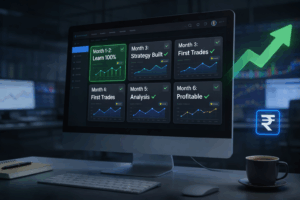
If you want trading to become a serious income stream and not just a hobby, you need a roadmap.
Define Your Big Picture Goal
Ask yourself what you want from trading:
- Extra monthly income
- Long-term capital growth
- The option to go full time in the future
Your answer will shape your risk tolerance and strategy.
Break It Into Measurable Milestones
Turn your big goal into smaller targets such as:
- “Execute 30 trades strictly following my rules this quarter.”
- “Keep risk per trade below 2% for the next three months.”
- “End the quarter with detailed journal notes for every trade.”
These milestones keep you accountable and trackable.
Essential Rules for Working Traders
Risk Management Is Your Safety Net
Risk management protects you when you cannot monitor the market continuously.
- Decide a fixed percentage of capital you are willing to risk on each trade.
- Place stop-loss orders so that you are protected even when you are away from the screen.
Survival is more important than any single winning trade.
Diversify Smartly
Do not put all your money into one or two trades.
- Spread risk across multiple stocks or setups.
- Avoid overexposure to one sector or theme.
Diversification helps you absorb inevitable losing trades without major damage.
Use Position Sizing Logically
Position size should be driven by risk, not by emotion.
- Bigger conviction does not always mean bigger size.
- Your position sizing formula should be simple and repeatable.
For example, you might risk 1–2% of total capital per trade, regardless of how “sure” something feels.
The Trading Journal: Turning Experience Into Progress
A trading journal is the bridge between “I think I am improving” and “I can see that I am improving.”
What to Record
For every trade, record:
- Date and symbol
- Entry and exit price
- Stop-loss and target
- Position size
- Reason for entry (setup and logic)
- Outcome and what you learned
- Emotional state during the trade
This may sound like extra work, but it quickly becomes your most valuable tool.
How Reviewing the Journal Helps
When you review your journal weekly or monthly:
- You will see which setups work best for you.
- You will notice repeated mistakes (late entries, moving stop-loss, overtrading, etc.).
- You can refine your rules based on evidence, not memory.
The journal makes your learning process faster and more objective.
When Is It Sensible to Consider Full-Time Trading?
Many people dream of quitting their job and trading full time, but very few prepare for it properly. Treat this as a long-term decision, not a quick reaction to a few winning months.
Signs You Might Be Ready (Eventually)
- You have been consistently profitable for at least 12–18 months with real money.
- Your trading income can reasonably match or exceed your monthly expenses.
- You have an emergency fund that covers 12–18 months of living costs.
- You can handle losing streaks emotionally without breaking your rules.
Even then, many traders choose to slowly reduce job hours or shift to flexible work before completely relying on trading.
Conclusion: Build Slowly, Trade Seriously, Keep Your Base Strong
Trading alongside a full-time job is not about being perfect; it is about being structured. When you combine a stable salary, a realistic trading style, disciplined risk management, and a habit of reviewing your trades, you create a powerful foundation.
You do not need to rush into full-time trading. Instead, use your job to support your learning curve, grow your capital, and give yourself time to become truly skilled. Over time, your results and your data—not your emotions—will tell you how far you can go with trading.