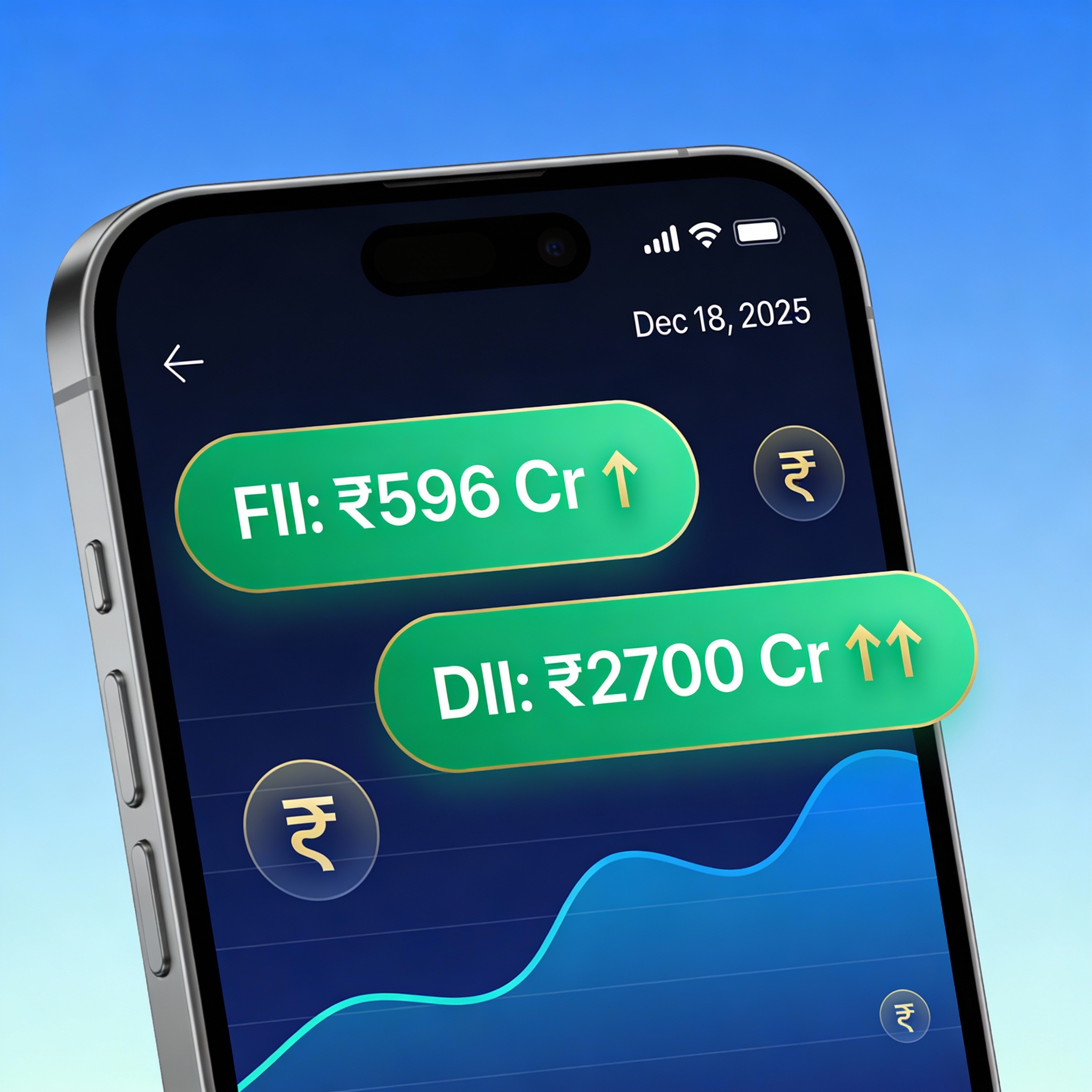
Foreign institutional investors (FIIs) made a significant shift on December 18, 2025, turning net buyers with an inflow of Rs 596 crore into Indian equities. This marks a notable change in sentiment after months of sustained selling pressure that saw FIIs offload over Rs 2.79 lakh crore worth of shares in 2025.
Domestic institutional investors (DIIs) continued their strong buying streak, pumping Rs 2,700 crore into the market on the same day, reinforcing their role as stabilizers amid foreign fund volatility.
FII and DII Trading Activity on December 18
The latest provisional exchange data reveals contrasting trading patterns between foreign and domestic institutions:
Foreign Institutional Investors (FII/FPI):
- Total purchases: Rs 11,442 crore
- Total sales: Rs 10,847 crore
- Net buying: Rs 596 crore
Domestic Institutional Investors (DII):
- Total purchases: Rs 12,376 crore
- Total sales: Rs 9,675 crore
- Net buying: Rs 2,700 crore
This single-day buying by FIIs offers a glimmer of hope that foreign investors may be reconsidering their bearish stance on Indian equities after prolonged outflows throughout 2025.
FII DII Trends: Year-to-Date Performance 2025
The broader picture for 2025 reveals a stark divergence between foreign and domestic investor behavior:
- FII net selling YTD: Rs 2,79,000 crore (₹2.79 lakh crore)
- DII net buying YTD: Rs 7,52,000 crore (₹7.52 lakh crore)
DIIs have emerged as the backbone of Indian markets, absorbing nearly every rupee sold by FIIs and adding Rs 4.73 lakh crore more. This massive domestic support has prevented steeper market corrections despite relentless foreign selling pressure.
Market Performance: Sensex and Nifty Remain Flat
Despite the positive FII inflow, benchmark indices closed largely unchanged on December 18:
- Sensex: Down 77.84 points (0.09%) at 84,481.81
- Nifty 50: Down 3 points (0.01%) at 25,815.55
- BSE Midcap: Flat with no significant change
- BSE Smallcap: Down 0.3%
The muted market reaction suggests investors remained cautious despite the FII buying, with sentiment still influenced by global uncertainties and currency-related concerns.
Sectoral Winners and Losers
Market activity remained stock-specific with mixed sectoral performance:
Top Performing Sectors:
- IT Index: Up 1%
- Realty Index: Up 0.3%
Underperforming Sectors:
- Auto: Down 0.3-1%
- Media: Down 0.3-1%
- Pharma: Down 0.3-1%
- Oil & Gas: Down 0.3-1%
- Capital Goods: Down 0.3-1%
Nifty Top Gainers and Losers December 18
Top Gainers:
- Interglobe Aviation (IndiGo)
- Max Healthcare
- TCS
- Infosys
- Tech Mahindra
Top Losers:
- Sun Pharma
- Power Grid Corporation
- Tata Steel
- Bajaj Auto
- Asian Paints
The strong performance of IT stocks reflects renewed investor confidence in the technology sector, possibly driven by stable global tech trends and rupee depreciation benefits for exporters.
Expert View: What’s Driving Market Sentiment
According to Ajit Mishra, SVP Research at Religare Broking, market sentiment continues to be shaped by global cues and currency volatility. “While intermittent buying was seen in select index heavyweights on a rotational basis, it was insufficient to drive a decisive directional move,” he noted.
Traders remain cautious, preferring selective stock-specific opportunities rather than broad-based market exposure. This explains why despite FII buying and strong DII support, benchmark indices failed to generate meaningful upward momentum.
Why FII Turned Buyers After Months of Selling
Several factors may have contributed to the FII buying on December 18:
- Attractive valuations: After sustained selling, certain stocks may have reached attractive price levels
- Year-end portfolio adjustments: Foreign funds often rebalance portfolios before calendar year-end
- Positive global cues: Improved sentiment in global markets
- Rupee stabilization: Reduced currency depreciation concerns
- Strong Q3 earnings expectations: Anticipation of decent corporate results
However, one day of buying doesn’t confirm a trend reversal. Investors should monitor FII flows over the coming weeks to assess whether this marks a sustainable shift in foreign investor sentiment.
What This Means for Retail Investors
The December 18 data offers important insights for individual investors:
Stay balanced: Don’t overreact to single-day FII flows; focus on long-term investing fundamentals
Watch DII support: Domestic institutions have proven to be reliable market supporters throughout 2025
Sector rotation: IT and realty showed strength; consider diversification across sectors
Stock-specific approach: With selective buying patterns, individual stock research becomes more critical than ever
Monitor global cues: Currency movements and international market trends continue influencing Indian equities
Investment Strategy Amid FII-DII Divergence
Given the contrasting behavior of foreign and domestic investors, here’s a prudent approach:
- Focus on fundamentally strong companies with sustainable business models
- Maintain adequate cash reserves to capitalize on market corrections
- Diversify across sectors benefiting from domestic growth stories
- Avoid overleveraging in volatile market conditions
- Track institutional buying patterns in your portfolio stocks
- Stay updated with quarterly earnings and corporate announcements
Conclusion
The Rs 596 crore net buying by FIIs on December 18, 2025, provides a brief respite after months of relentless selling. Combined with strong DII support of Rs 2,700 crore, Indian markets demonstrated resilience despite closing flat.
However, with FIIs still net sellers of Rs 2.79 lakh crore for the year, sustained buying is needed to confirm a trend reversal. DIIs continue to be the pillars supporting Indian equity markets, having absorbed massive foreign outflows with Rs 7.52 lakh crore in net purchases.
For investors, the message is clear: focus on quality stocks, maintain discipline, and let domestic growth drivers guide your investment decisions rather than short-term FII flow fluctuations.